Scattered Documentation
Manuals, datasheets, instructions, and SOPs are scattered across folders, apps, and separate archives.
Knowledge Intelligence for Manufacturing & Industry
AIDOCS connects technical files, structured data, SOPs, and operational know-how to deliver verifiable answers for production, quality, maintenance, and engineering.
Real Operational Challenges
In industrial enterprises, knowledge is often fragmented across manuals, SOPs, ERPs, technical archives, and individual know-how. AIDOCS unifies these sources into a searchable, controlled, and audit-ready platform.
Manuals, datasheets, instructions, and SOPs are scattered across folders, apps, and separate archives.
Staff risk relying on obsolete documents, local copies, or expired procedures.
Bills of Materials, recipes, components, and technical relations remain locked in tables or systems accessible only to a few specialists.
Experience, operational exceptions, and decision criteria often depend on key figures who are hard to replace or train.
Finding the right answer takes time, manual verification, and cross-referencing across multiple sources.
Not all information should be available to everyone: roles, departments, and responsibilities require different access levels.
Industry Use Cases
AIDOCS links document knowledge and structured data to empower operational, engineering, and managerial decisions across the production lifecycle.
Through parsing, chunking, and Blueprint creation, technical documents are converted into advanced structural indices. The DSRS-RAG engine queries sectioned text to provide precise responses with direct citations and clear source references, ensuring total transparency for engineering and shop floor staff.
By extracting entities and relationships from enterprise data, AIDOCS maps knowledge into a navigable graph (GraphRAG) connecting part codes, materials, percentages, and dependencies. Integrated with a rules engine (comparison, substitution, constraint, and compatibility rules), the platform enables automated structural comparisons and compliant proposal generation.
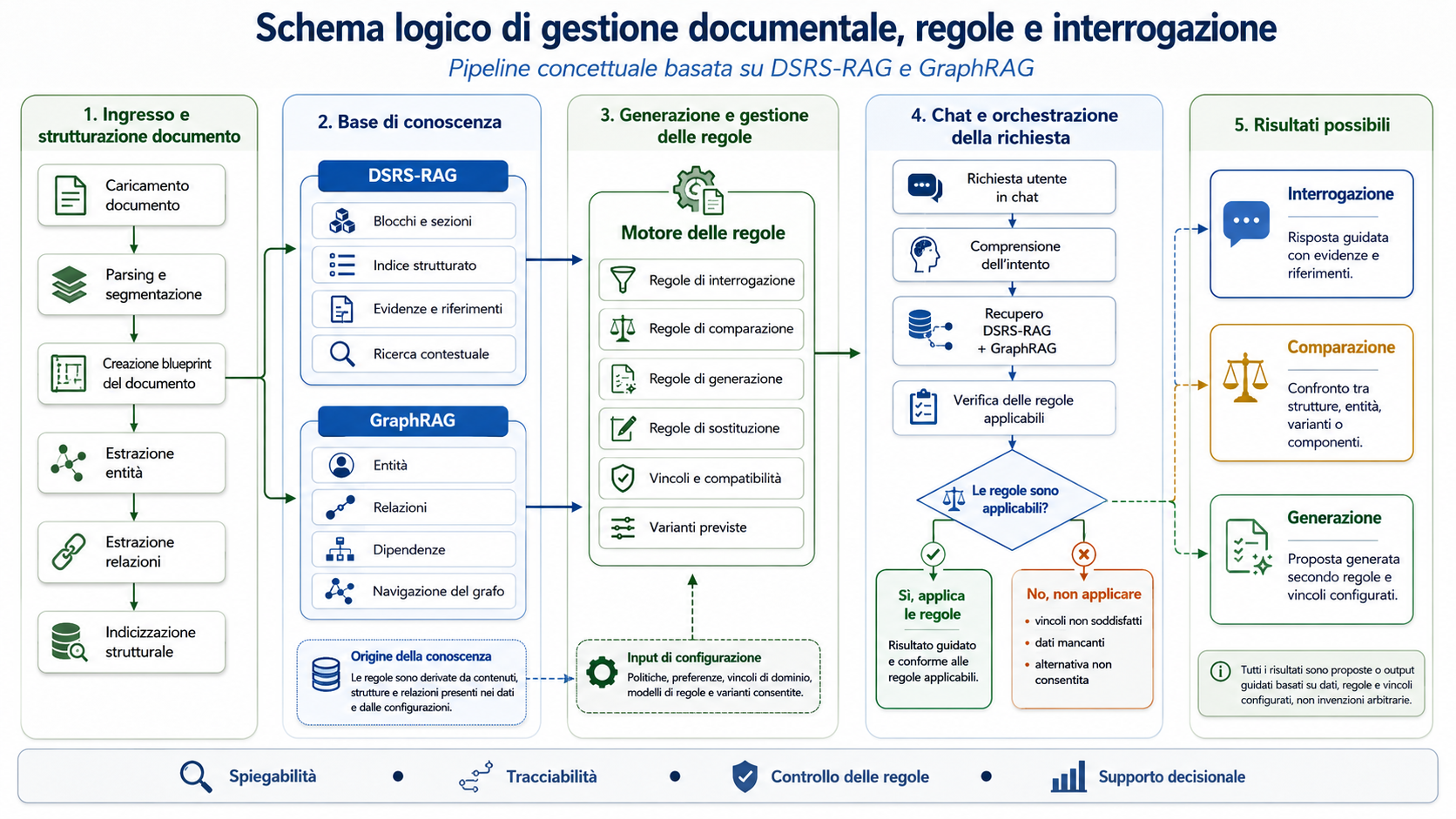
Organizing operating standards and compliance requirements via DSRS-RAG, AIDOCS normalizes quality manuals, SOPs, and troubleshooting guides. It validates safety constraints and role-based access for auditability and continuous process improvement.
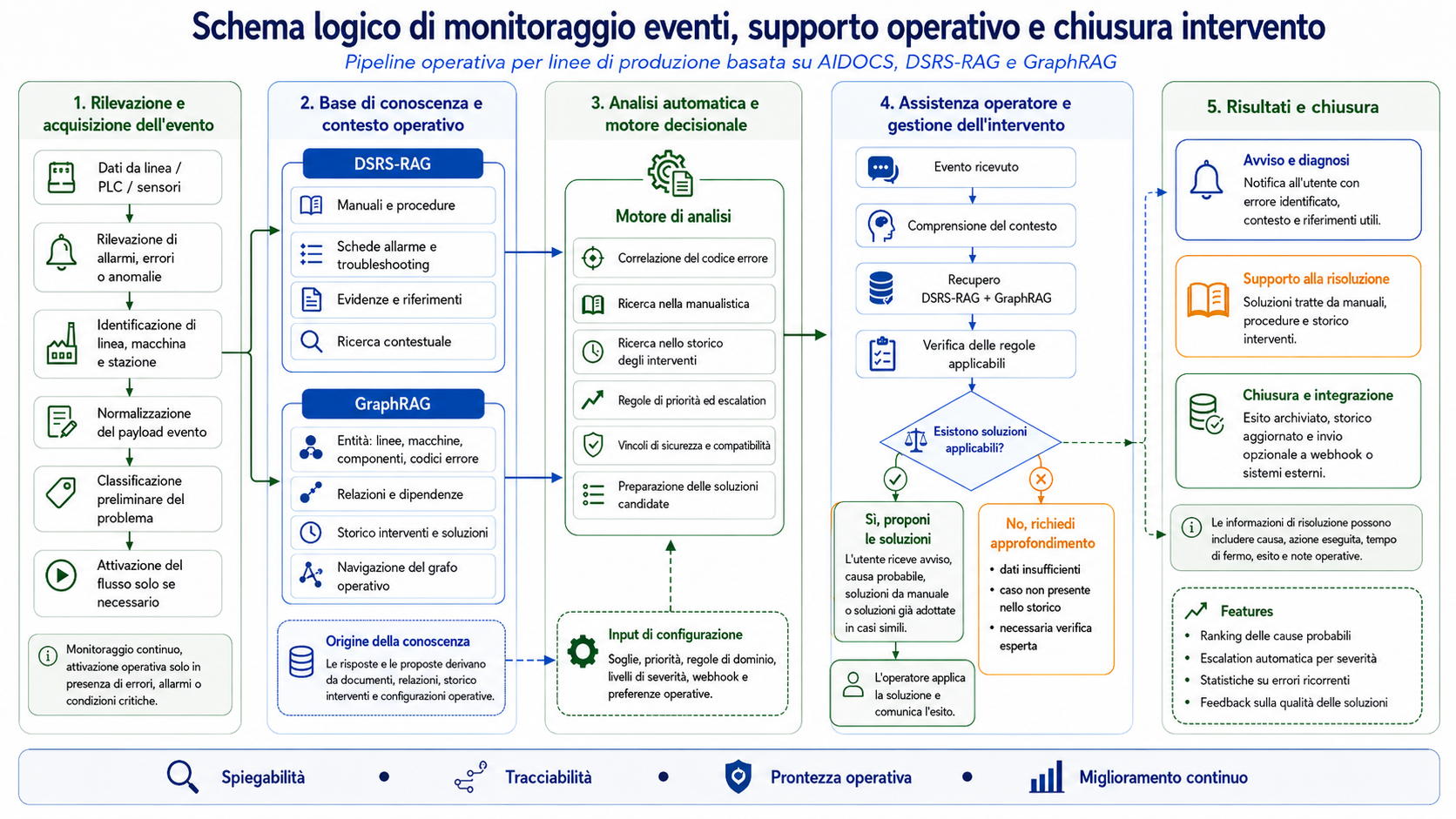
Events and anomalies from PLCs, sensors, IoT systems, or industrial applications can trigger AIDOCS workflows. The platform correlates operational context with manuals, procedures, technical data, and maintenance history to identify probable root causes and provide operators with verified actionable insights.
IoT Integration & Live Demo
AIDOCS is not just a document reader: it can receive events from industrial systems and use them to trigger analysis and knowledge retrieval workflows.
Select one of the sample alerts on the right panel: you will see how AIDOCS pipeline ingests the event, analyzes it via GraphRAG andDSRS-RAG, checks operational rules, and outputs a contextual assessment for the operator or calling system.
1. Select Test PLC Alarm:
2. AIDOCS Pipeline Execution:
Document & Relational Knowledge
AIDOCS utilizes distinct architectures tailored to knowledge types. Documents retain structural hierarchy and narrative context, while data, parts, and entities are connected through searchable relations.
DSRS-RAG
DSRS-RAG parses document structure, sections, tables, metadata, versions, and internal relations without reducing knowledge to isolated text chunks.
GraphRAG
GraphRAG links entities, part codes, materials, components, products, and dependencies, enabling cross-domain queries on industrial data.
Sample Cross-Domain Query
“Show me the Bills of Materials containing component K829507, indicate the percentage used, and retrieve linked technical procedures.”
Governance & Security
AIDOCS manages access levels, source files, versions, and rules according to your organizational structure, preventing unauthorized access across departments.
Users, roles, departments, and groups define authorized documents, datasets, and AI features.
The platform tracks document versions, validity dates, and active status, avoiding obsolete data usage.
AIDOCS deploys On-Premise or in dedicated Private Cloud environments, ensuring total data control.
Generated responses maintain direct citations to original source documents for human verification.
Application rules and domain structures guide retrieval, parsing, and response formatting.
AIDOCS does not lock organizations into a specific AI provider. Each Agent can leverage the most suitable model for its task—local or cloud-based—according to available infrastructure, security requirements, performance, and cost.
For specific tasks, Small Language Models (SLMs) can be fine-tuned or specialized using company domain terminology, examples, and data. Compact models can be dedicated to classification, information extraction, code recognition, and the interpretation of industrial procedures and workflows.
Industrial Process Integration
The platform integrates documents, structured data, and operational repositories, making them queryable by AI agents, apps, and workflows.
Bills of Materials, master data, orders, part numbers, and shop floor data linked directly to document knowledge.
Tables, records, part codes, and relations queried via domain-governed AI models.
AIDOCS ingests data from business services and returns responses or structured data via dedicated APIs.
Manuals, SOPs, datasheets, and quality records connected from multiple document management platforms.
Robots, sensors, and autonomous systems can send operational events directly to AIDOCS. The platform evaluates them against procedures, operating conditions, rules, and corporate knowledge, returning contextual feedback to the calling system or operator.
Frequently Asked Questions
Answers to common inquiries regarding technical documentation, industrial data, system integrations, access control, and deployment.
Yes. AIDOCS combines DSRS-RAG to parse technical document structures with GraphRAG to link Bills of Materials, components, part numbers, and relational data into unified AI queries.
Yes. AIDOCS connects with databases, REST APIs, ERP/MES platforms, and document archives based on your infrastructure and security policies.
AIDOCS tracks document versions, validity dates, source provenance, and authorization statuses to guarantee AI agents rely only on valid, up-to-date documentation.
No. Access permissions are segregated by user role, department, and operational group, ensuring AI agents only retrieve authorized information.
Yes. AIDOCS is deployable On-Premise or in Private Cloud, preserving complete organizational control over data, vector indices, and backend services.
Yes. Officina Tecnologica customizes AI agents, Blueprints, workflows, and interfaces dedicated to production, quality assurance, maintenance, R&D, and engineering.
No. AIDOCS allows configuring Agents with local AI models or external AI services, choosing the optimal fit for infrastructure, security requirements, performance, and cost constraints.
Yes. Small Language Models (SLMs) can be trained or specialized on company-specific domain data and terminology for targeted tasks such as classification, data extraction, part code recognition, or procedure interpretation.
Yes. Events from robots, PLCs, sensors, IoT systems, or industrial software can trigger AIDOCS workflows that correlate the operational context with documents, data, rules, and enterprise knowledge. AIDOCS delivers contextual insights and assessments to operators or systems without replacing machine control systems.